Climate and Sea

The research investigates climatic and ecological changes in the Baltic Sea region. The goal is to develop protection strategies and monitor ecological processes in order to preserve the Baltic Sea’s unique ecosystem. The focus is on sustainability and climate protection.
BlueGOV – Empowering Coastal Governance through Ocean Literacy

Project manager:
BlueGOV – Empowering Coastal Governance through Ocean Literacy
The project is investigating three pilot regions representing three European sea basins: Rügen/Baltic Sea, Šibenik-Knin/Adriatic-Mediterranean, and Oeiras/Atlantic regarding the barriers as well as best practices that exist for ocean literacy within local governance and across coastal communities. Based on these findings, training modules and a practical toolbox will be developed to enable local government agencies, institutions, associations, businsses, and other local stakeholders to make responsible and ocean-conscious decisions. At the University of Greifswald, the project is based at the Chair of Sustainability Science and Applied Geography within the Institute of Geography and Geology.
sustainable development, ocean literacy, coastbased administrations
Energy Transition in the Baltic Sea Region

Perceptions of Nordstream 2
The research project examines the legal and legal-political role of Nord Stream 2 before and after Russia’s attack on Ukraine. While questions of European law dominated before the war, the focus has afterwards been on aspects of international law. Discourse network analysis is used to analyse how legal arguments and stakeholder networks develop in this political process.
energy policies, Nord Stream 2, discourse network analysis
Social science analysis of the obstacles to an integrated energy market in the Baltic Sea region
The project investigates energy geopolitics in the Baltic Sea region and analyses the influence of material and non-material factors on regional energy policies. It examines different energy sources, national strategies and geo-economic dependencies and contributes to an understanding the fragmented energy cooperation.
energy geopolitics, energy sources, regional energy co-operation
Social science analysis of instruments to promote acceptance and engagement
The social science analysis of this project will focus on prosumer acceptance and engagement in the adoption of microgrids to investigate perceptions of risk among special interest groups.
risk perception, energy market, engagement

Nord Stream 2 and regional geopolitics in the Baltic Sea region
The research project examines the geopolitical impact of Nord Stream 2 on the energy policy of the Baltic Sea region before and after the Russian invasion in 2022, analyses how different concepts of energy security influence regional politics, and assesses the consequences of Russia’s geopolitical isolation on future energy cooperation.
climate protection law, energy trading in the Baltic Sea region, hydrogen technologies
Legal framework of climate change technologies
The project investigates the legal framework of climate change technologies in the Baltic Sea region, in particular their impact on trade with energy sources. It analyses whether common strategies or minimum standards are necessary to create an integrated market. It furthermore assesses the role of hydrogen and negative emission technologies.
climate protection law, energy trading in the Baltic Sea region, hydrogen technologies
Hydrogen and green hydrogen in the Baltic Sea region
The project investigates the part that hydrogen, especially green hydrogen, plays in the energy transition in the Baltic Sea region. It examines the fragmentation of national strategies and their impact on the development of a European and international hydrogen economy as well as its integration into the energy market.
hydrogen economy, energy transition in the Baltic Sea region, green hydrogen
Legal framework of hydrogen and green hydrogen
The project investigates the legal framework for hydrogen and green hydrogen in the Baltic Sea region. It analyses the coherence of national regulations, the role of European standards and the requirements for a common hydrogen market, especially with regard to cross-border hydrogen hubs.
hydrogen market, regulation, hydrogen hubs, EU energy law

Legal framework of a common energy market in the Baltic Sea region
The project investigates legal deficits in the implementation of a common energy market in the Baltic Sea region. It analyses gaps in EU law, obstacles to a coordinated energy policy, and possible legal instruments for market integration. A comparative law approach serves to identify regulatory barriers and possible solutions.
energy market regulation, EU energy policy, legal comparison

Legal analysis of instruments to promote acceptance and engagement
The project analyses legal instruments to support acceptance and engagement in the energy transition in the Baltic Sea region. It analyses the development of national legal systems with regard to prosumers and energy communities, identifies best practice examples and evaluates EU frameworks for citizen participation.
prosumer regulation, energy communities, citizen participation
Sustainability in the Baltic Sea Region
Baltic Sea Literacy
The project develops the concept of “Baltic Sea literacy” as a regional extension of “Ocean Literacy” to promote sustainable behavioural change in the Baltic Sea region. It investigates which factors influence Baltic Sea literacy and evaluates the willingness to adopt ocean-friendly behaviour through qualitative and quantitative surveys.
Baltic Sea literacy, ocean literacy, environmental behaviour
Behaviour change
This PhD project investigates how individual behavioural changes towards sustainable treatment of the sea occur, with a focus on the Baltic Sea. Subject of the analysis are external and personal factors, particularly the role emotions play as influencing factors. Data is provided by surveys and living labs. Research on ocean literacy has only just begun.
Based on: “Baltic Sea Literacy”
Baltic Sea literacy, ocean literacy, environmental behaviour
Political Feasibility
The project aims to develop the concept of “Baltic Sea Literacy” in a way that promotes sustainable behavioural change in the Baltic Sea region. A multi-stage survey analyses the ocean literacy of locals and tourists. The results shall contribute to the Decade of Ocean Science for Sustainable Development and will be used for policy consultation.
Baltic Sea literacy, environmental psychology, sustainability research
Policy Transfer
The project examines the conditions for a policy transfer in the Baltic Sea region for sustainable peatland use. So far, European agricultural policy has prevented regional adjustment. New control mechanisms of the CAP offer opportunities for a standardised Baltic Sea policy, dependent on EU guidelines and regional agenda setting.
policy transfer, agricultural policy, sustainable utilisation of peatlands

Antibiotics and resistant germs in the Baltic Sea
(PhD thesis completed)
The project analyses antibiotic resistance in the Baltic Sea region as part of the sustainability transformation. In cooperation with Greifswald University Medicine and the FLI, it examines antibiotic residues and resistant germs along the route from clinics via sewage treatment plants to the Baltic Sea and wild birds, using the “One Health” approach.
antibiotic resistance, One Health, sustainability transformation
OPENSPACES

Project manager:
OPENSPACES
OPENSPACES develops university courses in geoinformation sciences for Ukrainian students. By using free open source software, the project enables a form of learning that is independent of time and place without licence restrictions. It offers GIS courses, language courses and training for lecturers. It is funded by the DAAD and BMBF.
remote sensing, geoinformation processing, land use
Spatio-temporal Patterns of Fragmented Transformations
Annual monitoring of land cover and land use
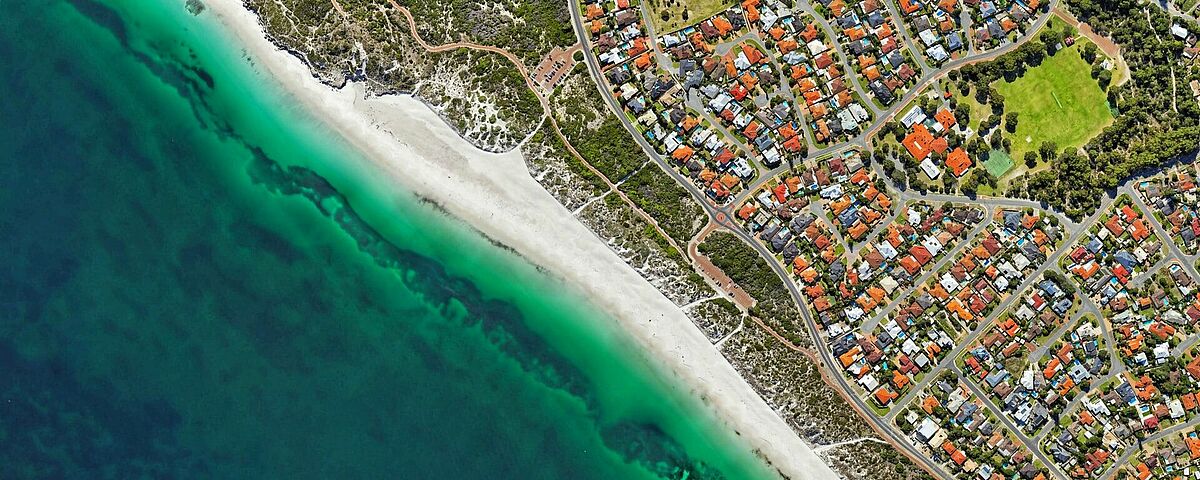
The work package investigates the standardised derivation and analysis of changes in land use by using satellite-based time series. Machine learning and spectral-temporal composites are used to create annual mappings in order to record vegetation trends and land conversions over large areas.
land use analysis, satellite data, machine learning
Interdisciplinary analyses of individual transformation processes
The quantitative results from the annual monitoring allow changes in land use to be analysed in detail. Expert knowledge helps us understand processes such as the dismantling of military facilities, and to generalise patterns. This allows for transformation paths to be derived and for new field studies to be designed in a targeted manner.
changes in land use, transformation pathways, field studies
Analysing spatio-temporal patterns along urban-rural gradients
The work package examines patterns of the settlement structure in growing and shrinking towns in the Baltic Sea region. Urban changes are analysed with the help of remote sensing data and socio-economic indicators. Historical maps and satellite data make it possible to draw a differentiated characterisation of urban development processes.
urban transformation, remote sensing analysis, settlement structure development
Interdisciplinary analyses of individual transformation processes
This work package combines cartographic analyses with socio-economic data in order to holistically capture urban shrinkage processes in the Baltic Sea region. In addition to statistic modelling, case studies with expert interviews and on-site collections will be conducted to identify political and institutional factors influencing urban development processes.
urban shrinkage, socio-economic analysis, mixed methods approach

Baltic Earth Observation and Geodata Repository
The goal of the project is to make spatio-temporal data products accessible for interdisciplinary research. This features the development of a web-based repository for harmonised geodata, including historical maps, to extend the period of analysis and facilitate interdisciplinary data use.
geodata integration, spatio-temporal analyses, data harmonisation
Atlas of Fragmented Transformations
The project prepares geodata from “Baltic earth observation and geodata repository & Atlas of fragmented transformations” in such a way that they can be used in an interdisciplinary manner. This includes the harmonisation, provision and integration of historical maps in the “Baltic earth observation and geodata repository”. A digital atlas visualises transformations with interactive maps and 3D representations.
geodata integration, digital geovisualisation, historical cartography