In terris Gryphi

Popularisation of the common cultural heritage of Pomerania for the local population and tourism (INT0300079)
The aim of the project is to use cross-border cooperation to preserve the common cultural heritage of the European Pomerania region and make it accessible to locals and tourists through digital innovations.
The project is based on digitised cultural treasures from Polish and German archives and libraries, such as documents, maps and photographs, which are processed using AI-supported technology. These form the basis for new tourist information services, publications and permanent exhibitions.
Duration 01.03.2025 until 29.02.2028
Contact In terris Gryphi
Old University Library
Rubenowstraße 4
17489 Greifswald
Phone +49 3834 420 1620
Fax +49 3834 420 1613
in-terris-gryphi@uni-greifswald.de
in-terris-gryphi[at]uni-greifswald.de
What is POMERANIA?
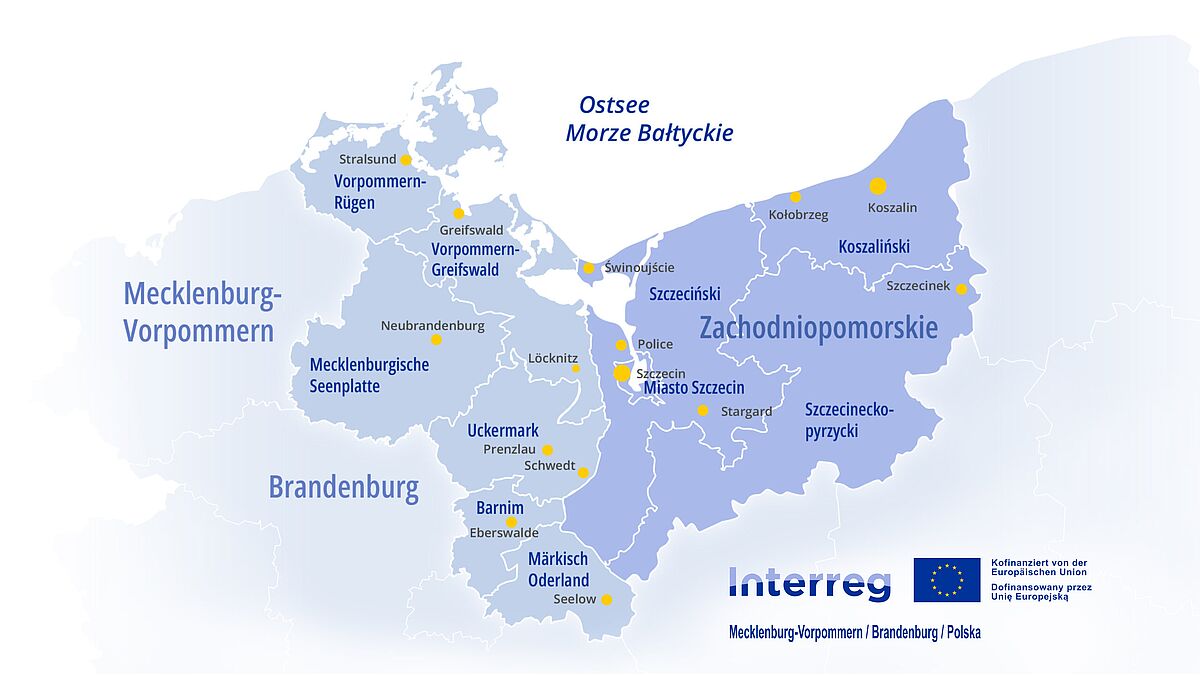
The Euroregion POMERANIA is a cross-border region in which municipalities and municipal associations close to the border in Germany and Poland participate. It comprises five German districts (Vorpommern-Greifswald, Mecklenburgische Seenplatte, Vorpommern-Rügen in Mecklenburg-Western Pomerania, as well as Uckermark and Barnim in Brandenburg) and the West Pomeranian Voivodeship in Poland. However, the region is not only connected by structural but also geological, cultural-historical and scenic similarities.The landscapes are equally shaped by the Ice Age, are relatively sparsely populated and are predominantly used for agriculture.
The historical similarities in particular are to be brought to life as part of the project through multilingual digital content and educational events.
The Euroregion covers a total area of 35,000 km2 and is home to 2.7 million inhabitants.
Partners:
The Greifswald University Library coordinates the project and implements it together with the Książnica Pomorska (the Pomeranian Public Library) in Szczecin and the Mecklenburg-Vorpommern State Office for Road Contruction and Transport.
Associated partners are the Mecklenburg-Vorpommern Tourism Association, the Schwerin State Archive and the Brandenburg State Road Authority.
Who is funding the project?
The project is being funded as part of the Interreg VI A program. The Interreg VI A program Mecklenburg-Vorpommern / Brandenburg / Polska 2021-2027 supports German-Polish cooperation in the border region with funds from the European Regional Development Fund (ERDF) within the framework of the "European Territorial Cooperation" objective.
The total funding amounts to 3.57 million euros, of which 2.84 million euros (80 per cent) will be provided from ERDF funds. The remaining amount is contributed by the partners themselves.
The use of the European Regional Development Fund (ERDF) is primarily aimed at continuing the economic catch-up process in Mecklenburg-Vorpommern through investment and enabling it to shape the future based on its resources. The funding is primarily intended to strengthen the innovative powers and competitiveness of companies and to support research and development activities in order to broaden the state's economic base and create more jobs in the primary labour market.
Subprojects
Four public conferences are planned on topics including ‘Avenues in MV’, ‘Translating Polish literature into High and Low German’ and the ‘125th anniversary of the Pomerania Library in Szczecin’. Moreover, a travel guide ‘Mysterious Pomerania’ and two permanent exhibitions on the ‘Pomerania Space’ and ‘Chaussee Avenue Milestones and Chaussee Houses’ are important milestones of the programme.
As part of the project, we want to make digital copies of special documents available to towns, villages and communities that are celebrating major anniversaries in the next ten years.
The first documents that have been digitised as port of the project can be found here.
Team
In terris Gryphi
Popularyzacja wspólnego dziedzictwa kulturowego Pomorza dla ludności i turystyki
Projekt Interreg VI A „In terris Gryphi – Popularyzacja wspólnego dziedzictwa kulturowego Pomorza dla ludności i turystyki” ma na celu zachowanie wspólnego dziedzictwa kulturowego europejskiego regionu Pomorza i udostępnienie go mieszkańcom regionu i wczasowiczom poprzez innowacje cyfrowe i współpracę transgraniczną. W projekcie uczestniczą partnerzy z Meklemburgii-Pomorza Przedniego, Brandenburgii i Polski.
numer projektu: INT0300079
W ramach realizacji celów szczegółowych projektu dotyczących edukacji, kultury i zrównoważonej turystyki ułatwiony zostanie dostęp do wiedzy o wspólnej historii Pomorza oraz promowana będzie jej popularyzacja. Wielojęzyczne treści cyfrowe, interaktywne formaty nauczania i innowacyjna oferta edukacyjna wzmacniają kompetencje międzykulturowe mieszkańców i gości regionu objętego projektem. Ponadto dokumenty historyczne, mapy i fotografie będą digitalizowane i udostępniane bezpłatnie za pośrednictwem platformy wielojęzycznej. Nowe usługi informacji turystycznej, wydawnictwa i wystawy stałe mają na celu udostępnienie szerokiemu gronu odbiorców bogatego dziedzictwa kulturowego Pomorza.
Projekt jest koordynowany przez Bibliotekę Uniwersytecką w Greifswaldzie. Partnerami projektu są Uniwersytet w Greifswaldzie wraz z Instytutem Geografii i Geologii oraz Biblioteką Uniwersytecką, Książnica Pomorska im. Stanisława Staszica w Szczecinie oraz Krajowy Urząd Budowy Dróg i Transportu Meklemburgia-Pomorze Przednie w Rostocku i Neustrelitz. Partnerami stowarzyszonymi są Stowarzyszenie Turystyczne Meklemburgii-Pomorza Przedniego, Archiwum Państwowe w Schwerinie oraz Zarząd Dróg Krajowych Brandenburgii.
Okres realizacji: 1 marca 2025 r. – 29 lutego 2028 r.
Projekt jest finansowany ze środków Europejskiego Funduszu Rozwoju Regionalnego (EFRR) w ramach programu Interreg VI A Meklemburgia Pomorze Przednie/Brandenburgia/Polska 2021-2027. Łączna kwota finansowania wynosi 3,57 mln euro, z czego 2,84 mln euro (80 proc.) pochodzi ze środków EFRR.